
The Weaponisation of Palestine: When Antisemitism Wears the Mask of Justice
- Samuel Bartlett

- Jun 6, 2025
- 7 min read
What happens when a movement for justice begins to tolerate, and even promote, antisemitism? This last month shows that Jewish blood is spilled as a consequence. On May 21, Yaron Lischinsky and his partner, Sarah Lynn Milgrim, were shot dead at the Capital Jewish Museum in Washington, DC. The shooter, who targeted them solely for being Jews attending a Jewish event, was arrested while screaming the all too familiar phrase, “Free Palestine”. Less than two weeks later, in Colorado, a man attempted to murder a group of demonstrators calling for the release of Israeli hostages in Gaza by carrying out a firebomb attack using Molotov cocktails and a makeshift flamethrower. 15 people were injured, including an 88-year-old Holocaust survivor. Similarly, the attacker yelled “Free Palestine” during his attack, with an affidavit revealing he intended to kill all Zionists.
For many in the Jewish community, the unfortunate reality is that these attacks were not surprising; they were expected. What was new, however, was the motives of the attackers. Previous deadly antisemitic attacks in America were carried out by white supremacists, such as the 2018 Tree of Life synagogue shooting in Pittsburgh. Philissa Cramer, editor-in-chief of the Jewish Telegraphic Agency, observes that until these recent attacks in Washington and Colorado, “there had not been a deadly attack on a Jewish institution carried out by someone who appeared to be primarily motivated by far-left pro-Palestinian activism”. Throughout contemporary history, antisemitism has evolved, often disguising itself as criticism of Israel. Today, we see this expressed in the vitriol within the ‘Free Palestine’ movement.
This has been most clearly demonstrated on university campuses and streets across many Western countries in recent years. In the United States, prestigious institutions such as Harvard and Columbia have been criticised for failing to protect Jewish students amid a surge in antisemitism following October 7. In the United Kingdom, weekly marches through the capital frequently featured antisemitic placards invoking Holocaust inversion and blood libel. Meanwhile, the ‘Free Palestine’ movement galvanised streets across Europe. The lines between legitimate criticism of Israel and antisemitism once again blurred, with Jewish communities painfully familiar with the consequences.


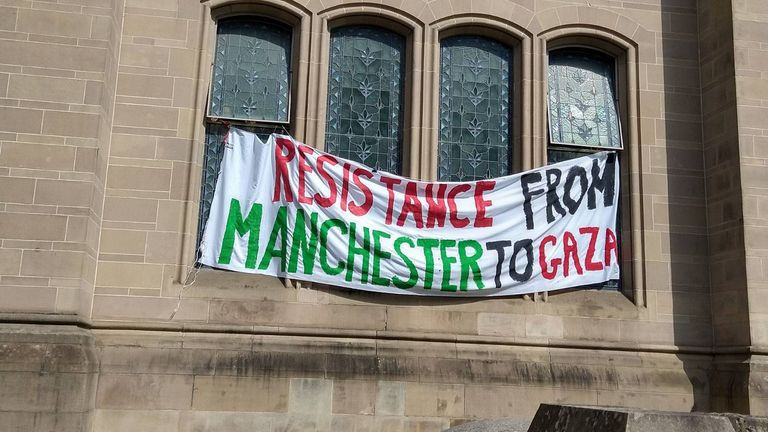
I witnessed this firsthand. In March, pro-Palestinian students at the University of Manchester submitted a ‘Solidarity with Palestine’ motion to the Students’ Union Assembly. Among its demands, the motion called on the Union to recognise that “the people of Palestine have the right to armed resistance under international law”, and to replace the IHRA definition of antisemitism with the Jerusalem Declaration on Antisemitism.
I attended the Assembly, where students debated the motion and were allowed to propose amendments. Unsurprisingly, Jewish students were vastly outnumbered. At my table sat several pro-Palestinian students, most wearing keffiyehs and face coverings, choosing anonymity over open engagement. Despite their strong presence, many seemed unfamiliar with even the basic dimensions of the Israeli/Palestinian conflict. When I referenced the Clinton Parameters, central to past peace efforts, they hadn’t heard of them and laughed at any proposal not rooted in a one-state solution.
In fact, the motion explicitly endorsed a one-state model, alongside the right of return for all Palestinian refugees, a position that would effectively end Israel as a Jewish state. When I pointed out that most Palestinians do not support a one-state solution, citing data from the respected Palestinian Center for Policy and Survey Research, the students seemed unfamiliar with the organisation. Rather than engaging with its findings, they dismissed the results altogether, suggesting that Palestinians “can’t be surveyed”. While it is reasonable to question the limitations of polling, the surveys conducted by the Palestinian Center for Policy and Survey Research provide rare and valuable insight into Palestinian public opinion, insight that is often missing from outside discourse.
When I asked why they were promoting a political solution that most Palestinians themselves do not support, they had no real answer. According to the PCPSR’s May 2025 poll, 47% of Palestinians support a two-state solution based on the 1967 borders, while only 14% favour a single binational state. That doesn't indicate widespread enthusiasm for the two-state model, but it does show that Palestinians prefer it far more than the one-state alternative. In championing a one-state solution, these students were not only ignoring Palestinian voices, they were actively opposing them. Regardless, advocating for a one-state solution is an unacceptable fantasy, utterly detached from the realities of the Arab/Israeli and Israeli/Palestinian conflict.
We pressed them on what they meant by ‘the right to armed resistance’ and who could be targeted under that banner. The answers were evasive, but chilling. When a Jewish student at our table asked whether, by that logic, his elderly relatives living in Israel could be considered legitimate targets, one student replied, “It depends”. The implication was stark: Jews, simply by existing in the historic Jewish homeland, could be deemed killable.
It was no surprise that they lacked historical and political knowledge. For many, the ‘Free Palestine’ movement isn’t about Palestinians, it’s about themselves. Cloaked in moral vanity, they are consumed by their own self-righteousness. Many within the movement do not genuinely care about the well-being of Palestinians, who have become symbolic faces of oppression for the progressive left. To them, Palestinians are little more than pawns, useful tools in a broader agenda. Their concern lies less with Palestinians’ future than with the destruction of Israel. There is no concern for genuine political solutions to the occupation of the West Bank, nor for the freedom of Palestinians from a brutal terror group in Gaza or a corrupt, ageing leadership in Ramallah.
When it came time to propose amendments, Jewish students offered several. One suggested that any change to the definition of antisemitism should be made in consultation with Jewish groups. It was rejected by a majority. Another amendment proposed clarifying that ‘armed resistance’ must never include the targeting of civilians. This, too, was rejected, even after it was made clear that this would include children.
I left the Assembly thinking of David Baddiel’s argument that ‘Jews don’t count’. In that room, Jewish students were told that their families might be acceptable targets for violence, and were denied a voice in defining antisemitism. That, more than anything, laid bare the antisemitism hiding in plain sight.
The radical liberation ethos of the ‘Free Palestine’ movement is seductive. As former Israeli diplomat Shlomo Ben-Ami notes, for national liberation warriors, nations are born in war, not around the negotiating table; there is a requirement for bloodshed and radicalism. Armed liberation is attractive and alluring; negotiations and diplomacy are tedious and mundane. For young students, especially, it is easy to be drawn in by the marches and protests, which often attract thousands of attendees. Enthralled by performative dimensions, the noise, and the chants, the collective euphoria is intoxicating. But when individuals commit injustices in the name of justice, this signals the moral collapse of a movement.
In fact, listening to the movement reveals their true intentions. Chillingly, “Globalise the Intifada” has become one of the movement’s most popular chants in recent years. The Second Intifada, a violent Palestinian uprising in the early 2000s, was marked primarily by a wave of suicide bombings targeting Israeli civilians. While some argue that ‘Intifada’ simply means ‘uprising’ and carries no malicious intent, it is impossible to separate the term from its historical context. Those in Israel and Palestine are all too familiar with the devastation and brutality of the First and Second Intifadas. To “globalise the Intifada”, then, is to endorse the spread of such violence beyond the region, indiscriminately targeting those who support Israel around the world. Given that the vast majority of Jews support or feel a deep connection to Israel, this effectively renders Jewish institutions and communities the targets of this global campaign.
While the chant “Globalise the Intifada” is explicit in its intent, “Free Palestine” is far more ambiguous, and that is precisely its strength. As writer Samuel J. Hyde notes, the brilliance of the “Free Palestine” slogan lies in its vagueness, allowing it to be adopted by both progressives and Islamists. He goes on to write, “In the poisoned moral economy of ‘Free Palestine’, Jewish blood is a form of currency to be spilled.” Tragically, recent weeks have provided chilling evidence of this.
To be clear, antisemitism should not be used as a blanket label for the entire ‘Free Palestine’ movement. Baseless accusations are harmful and risk diluting the term, especially at a time when antisemitism is at an all-time high. There is a real need for genuine political and academic engagement on the Palestinian front. However, the hatred present within the movement is undeniable. As Jacob Miller, former president of Harvard Hillel, argues, opposition to the movement should not rest solely on its antisemitism, but also on the “simplistic thinking, extremist rhetoric, and implicit justification and support of violence” expressed by many of its members. But therein lies another problem: the progressive left is too often dominated by a binary worldview—good versus bad, virtuous versus evil, oppressor versus victim. There is little room for nuance. And without nuance, understanding one of the most complex geopolitical conflicts of the past century becomes impossible.
Unfortunately, having an enemy is easy; making peace is hard. It demands an understanding of the other side and a daily commitment to building a better future for both peoples. Diplomat Gamal Helal, who served as a translator during the Camp David Process, remarked that “it’s a mistake to assume that all sides [Israelis and Palestinians] are eager to have peace,” noting that “a lot of parties feel comfort in the past”. This applies not only to Israelis and Palestinians themselves, but also to many of their advocates. Pro-Israel and pro-Palestinian activists alike often find it easier to vilify the other than to engage in difficult, uncomfortable conversations. One of the most glaring problems on both sides is a profound lack of education about the conflict. Without a deeper understanding, peace becomes impossible. For many within the ‘Free Palestine’ movement, there is no real stake in the conflict. They are neither Jewish, Israeli, nor Palestinian. The issue bears no direct consequence on their lives. They aren’t required to spend countless hours educating themselves, they can attend marches, chant slogans, and then return to their day-to-day lives unaffected. I’ve said for years that despite how alluring the Israeli-Palestinian conflict may be, you don’t need to have an opinion on it. If you’re not willing to dedicate serious time to academically understanding the issue in depth and contribute constructively, then you are not required to have an opinion. There’s a false belief, especially when it comes to trending or emotionally charged topics, that everyone must have a stance. But this conflict is not a spectacle, it deserves more than shallow takes and hateful rhetoric.
The tragedies of the past month should prompt serious introspection within the ‘Free Palestine’ movement. What is needed now is not more slogans, but moral clarity. What is it you truly seek, a future where Palestinians live in dignity with self-determination? Or the destruction of Israel, with Jewish institutions and communities around the world treated as collateral damage in that pursuit?
Comments